
Dates
19 octobre – 19 décembre
En 1953, Calder revient s’installer en France pour la première fois depuis vingt ans : d’abord dans la campagne aixoise, puis dans le village de Saché, en Indre-et-Loire. La créativité de l’artiste s’épanouit dans les vastes paysages provençaux, puis entre les murs d’une modeste maison en pierre du XVIIe siècle, isolée, baptisée « François Premier », à Saché. L’année suivante, à Paris, la galerie Cahiers d’Art expose les encres et les gouaches réalisées à Aix, tandis que la galerie Maeght présente « Aix. Saché. Roxbury. 1953-54 ». Ces deux expositions marquent le retour triomphal de Calder en France.
Plus de soixante-dix ans plus tard, fruit d’une heureuse coïncidence, l’exposition « Calder : François Premier » investit les espaces de Hauser & Wirth Paris — un hôtel particulier situé, comme il se doit, rue François 1er. C’est le premier projet d’envergure consacré à cette période foisonnante d’après-guerre dans la vie et l’oeuvre de l’une des figures majeures de l’art du XXe siècle.
L’exposition offre à de nouvelles générations l’occasion de découvrir deux oeuvres extraordinaires : « Les Granettes » (1953), grand mobile sur pied présenté pour la première fois depuis soixante-douze ans, et « The Putney Mobile » (1954), qui fait ses débuts européens sept décennies après sa création. Ces chefs-d’oeuvre sculpturaux sont accompagnés d’un important ensemble d’encres, de gouaches et d’autres travaux réalisés au cours des années charnières de 1953 et 1954.
À propos de l’artiste
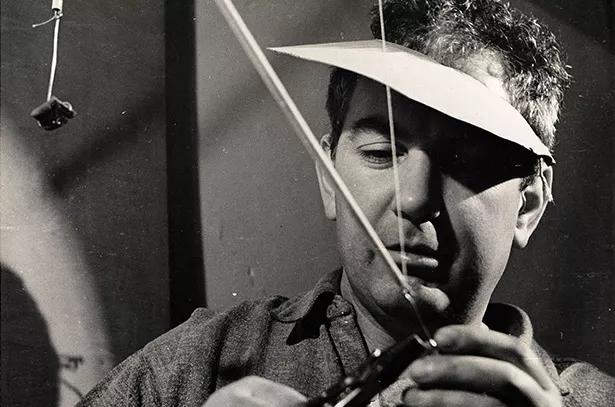
Alexander Calder
Alexander Calder was born in 1898, the second child of artist parents—his father was a sculptor and his mother a painter. In his mid-twenties, Calder moved to New York City, where he studied at the Art Students League and worked at the ‘National Police Gazette,’ illustrating sporting events and the Ringling Bros. and Barnum & Bailey Circus. Shortly after his move to Paris in 1926, Calder created his ‘Cirque Calder’ (1926–31), a complex and unique body of art. It wasn’t long before his performances of the ‘Cirque’ captured the attention of the Parisian avant-garde.
In 1931, a significant turning point in Calder’s artistic career occurred when he created his first kinetic nonobjective sculpture and gave form to an entirely new type of art. Some of the earliest of these objects moved by motors and were dubbed ‘mobiles’ by Marcel Duchamp—in French, mobile refers to both ‘motion’ and ‘motive.’ Calder soon abandoned the mechanical aspects of these works and developed suspended mobiles that would undulate on their own with the air's currents. In response to Duchamp, Jean Arp named Calder's stationary objects ‘stabiles’ as a means of differentiating them.
Calder returned to live in the United States with his wife, Louisa, in 1933, purchasing a dilapidated farmhouse in the rural town of Roxbury, Connecticut. It was there that he made his first sculptures for the outdoors, installing large-scale standing mobiles among the rolling hills of his property. In 1943, James Johnson Sweeney and Duchamp organized a major retrospective exhibition at the Museum of Modern Art, New York, which catapulted Calder to the forefront of the New York art world and cemented his status as one of the premier American contemporary artists.
In 1953, Calder and Louisa moved back to France, ultimately settling in the small town of Saché in the Indre-et-Loire. Calder shifted his focus to large-scale commissioned works, which would dominate his practice in the last decades of his life. These included such works as ‘Spirale’ (1958) for the UNESCO headquarters in Paris and ‘Flamingo’ (1973) for Chicago’s Federal Center Plaza. Calder died at the age of seventy-eight in 1976, a few weeks after his major retrospective, ‘Calder’s Universe,’ opened at the Whitney Museum of American Art, New York.
Current Exhibitions


1 / 12