

Conversations
The Color of Sound
A conversation between Lorna Simpson and Jason Moran about the elective affinities between art and music

Lorna Simpson wearing Bottega Veneta, March 2026. Photo: Jeff Henrikson
On the occasion of “Lorna Simpson: Third Person,” a major new exhibition that opened in March at Punta della Dogana in Venice, organized in partnership with the Metropolitan Museum of Art in New York, Simpson sat down recently with acclaimed pianist and composer Jason Moran, a frequent collaborator, to talk about the ways in which their respective work is informed and enriched by each other’s genre.
The conversation, which took place when Simpson’s and Moran’s schedules aligned in Los Angeles, looks ahead to the next work the two plan to create in partnership, a new musical performance by Moran involving Simpson sculptures made with singing bowls, reprising Stacked Stones/Vibrating Cycles, a version of the work that was staged in 2021 at Hauser & Wirth Downtown Los Angeles.
Lorna Simpson: Thank you so much for being here to do this today.
Jason Moran: To, as they say, chop it up. It’s very much my pleasure, and it’s good to see you again. Should we just start? Or pick up where we left off last time? We’ve known each other a long time.
LS: We have.
JM: I kind of want to start by talking a little about you growing up in Queens.
LS: Okay.
JM: I wonder if you remember some of the earliest sounds you heard when you were growing up.
LS: Actually, one of the earliest sounds that I remember was from John Coltrane. My parents had a record player that you could stack albums on, and it would play one and then another would drop down and play. I remember specifically John Coltrane’s Ballads album. I listened to that incessantly because it was just played incessantly in our home. Becoming an adult and hearing it again in my twenties, I realized that I knew the music by heart. That’s how closely I listened to it.
JM: He and that band were some of the best musicians in the world who knew how to play slowly, which is the most difficult thing to do. It’s easier to play fast, and to do an entire record of ballads was something special. I’m kind of shocked to hear that you paid attention to it as a kid, because I think about the energy of a young child as frenetic and here’s this very slow record you’re listening to.

Installation view of “Lorna Simpson: Third Person” at Punta della Dogana, Venice. Artworks: Vibrating Cycles, 2026; on walls, left to right: Night Fall, 2023; Thin Bands, 2019; Time, 2021; Howling, 2020 © Lorna Simpson. Photo: James Wang
LS: Well, I was an introspective child. It was like the opposite of watching cartoons. The abstraction of the melodies was of course over my head at that time, but the fact is that I committed that abstraction to memory, in a way. I didn’t know the original ballads, the source material. I just took in what Coltrane did with it.
JM: We were talking earlier today about the way brilliant people, like you, make the old new. Coltrane was, in those moments, taking songs that were, I’ll just say, pretty mediocre. But when he plays them he layers so much onto them that people keep coming back to them as a source of energy. And thinking about that reminds me of Easy to Remember, your piece from 2001, where you show mouths humming Coltrane’s recording of the Rodgers and Hart tune “Easy to Remember.”
LS: I thought of that piece as an invitation to improvise on an improvisation, and just to record it and get to watch it happen was an incredible gift. Even for professional singers, everyone had to adjust where they wanted to begin, in terms of octave, how to sustain notes, how to keep track, so to speak, with the music. It was amazing.
JM: Did you ever think of yourself as a filmmaker?
“There’s something about the process of coming to ideas, and that formulation is the thing I hold onto the most, not so much the end product, the object. As an object, it’s a thing that contains the experience of making it.”—Lorna Simpson
LS: Well, that piece was filmed. It was a performance, in a way. It’s also a recording of a performance. For me, sound and music in my work always go back to the body, whether it’s humming with Easy to Remember or whistling with Cloudscape [2004]. We’ll probably talk soon here about the vibrating cycles of the singing bowls and the way that those vibrations affect the body as you play. When I think about your work, I think about how you reframe, in a Coltrane way, what you’re listening to or what you’re looking at. It’s always a positioning and a reframing and a re-layering, while also paying tribute. Your new release, Jason Moran Plays Duke Ellington, I kind of interpret as a tribute to Ellington, your fondness for the music and its deep inspiration, but it’s also very multilayered. His persona seems to be something that’s very much a part of the music—the man and the music, a man who had to develop a certain kind of persona in order to make the music he wanted to make at a particular time in American history.
JM: Right. He has a tuxedo on and his hair is conked and he’s got a really sweet, elegant sense about him. But there’s something else going on.
LS: Right. Like: Don’t get on his bad side. Don’t ask any stupid questions.
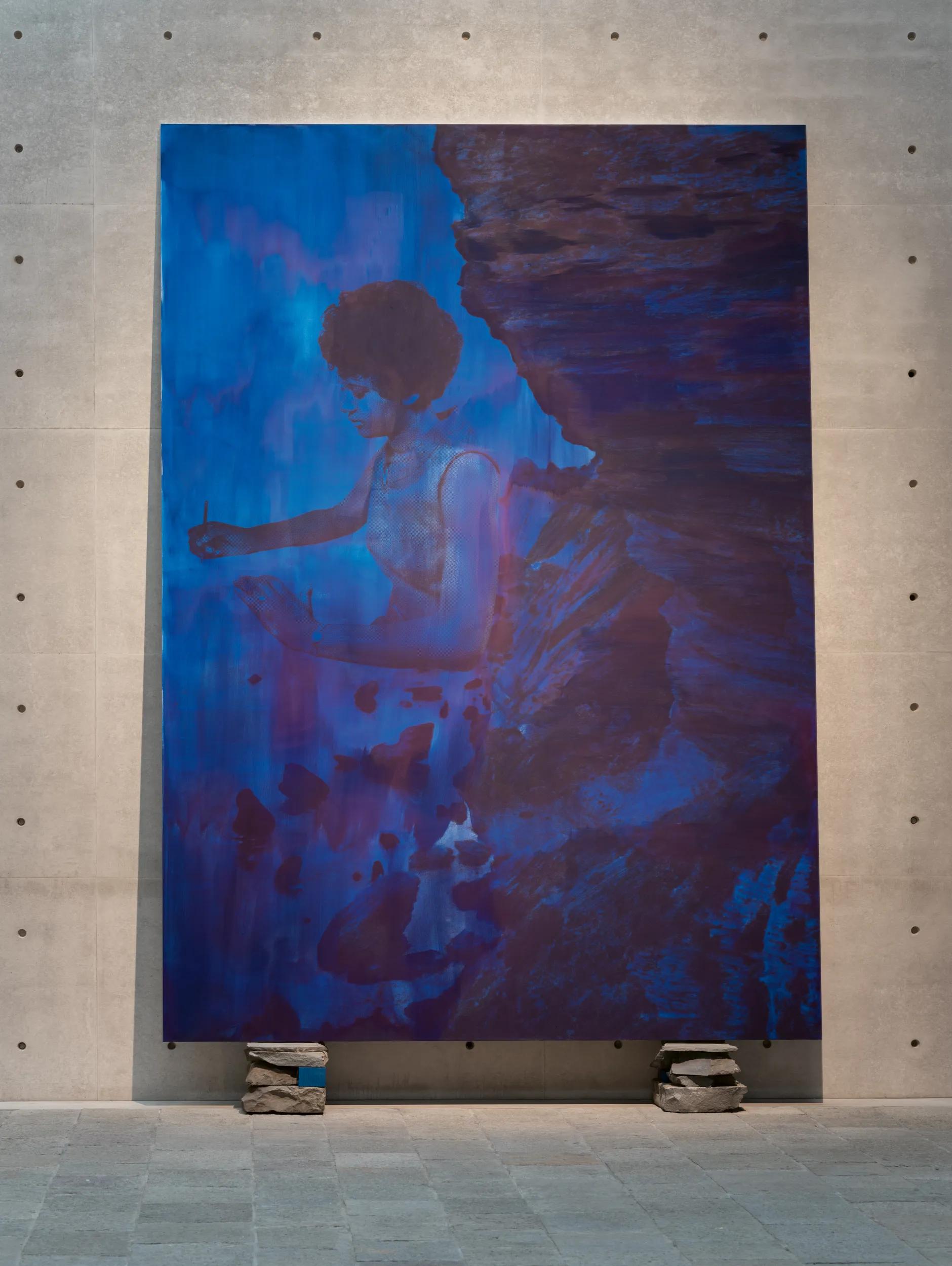
Lorna Simpson, Cliffs, 2025 © Lorna Simpson. Photo: James Wang

Lorna Simpson, did time elapse, 2024 © Lorna Simpson. Photo: James Wang
JM: Exactly. That veneer didn’t mean he didn’t have a hammer in his back pocket. There was a ferocious ambition and vision and drive. I think especially about how he played. As a pianist, I think he really informed most of the later 20th-century pianists in how to attack the instrument. And that’s what I inherit from him. I consider him definitely part of the family tree that I’m from, musically. And ideologically, too. He reinvents what he considers an American orchestra, and that orchestra is Black, and he makes a new language with it, with his collaborators, a language that’s highly layered. In making the Ellington work, I thought about how you’re always playing for the people who are near, but you’re also playing for the people who are far, who are not even on this earthly plane anymore. And all of those people, your audience, kind of live together. You can make waves that find them. I don’t want to make it sound like some hocus pocus, but I firmly believe in it.
LS: The magic. Yeah.
JM: I also think that’s what makes music one of the most threatening vehicles we have right now as artists. So often you hear the rhetoric that it’s pointless, especially jazz. There’s the knock that it doesn’t earn any money. But Duke Ellington stands there as a person who says, “Nah. There’s something in here. Something actually dangerous and revolutionary in music.” He also says, “I didn’t discover everything in it, so you’re going to have to try to go the rest of the way.” And this record is really just a way to honor him and sit alone at the instrument and try to do that.
LS: We mentioned reframing a minute ago but I also think about free association in your work, and in mine.
JM: We were walking through the Eileen Harris Norton show here just now and seeing your piece in the show, You’re Fine [1988], and I was thinking about these moments when you decide to segment things, segment a body. One photograph becomes four parts. I think about how many ways you work.
LS: You also, I mean, within your studio itself, there’s always been your piano and then this other space.
JM: A mess!
LS: Ha. Maybe. But your work ebbs and flows between music as an inspiration and then to other things, to visual art as a prompt. Which you also make. What did you call that work you made a few years ago?
JM: Oh, Dedicated to the Manual [2020]?
LS: Right! During the pandemic, where you played the piano and recorded your hand and finger movements in paper soaked in pigment and a series of abstract-like drawings resulted from that. I mean, that variation, that lack of distinct boundaries in your work, has always been very interesting to me.
JM: When I was a young artist I remember seeing your work and Glenn Ligon’s work and that of a few other artists and I’d tell myself, “Oh, okay, this is what they do.” And then I saw the next show and I was like, “Wait a minute. I didn’t know they did that.” And then I saw the next show and I was like, “Wait a minute. How are we now over here?” And then I thought, “Oh … shit.” It made me think about how Coltrane went through a lot of music before he died.
LS: Very quickly.
“I’ve been saying to not only myself as a performer but also to younger musicians who I work with: We go onstage to make music, but we’re also responsible for how we send our audiences back out into the world. It’s on us. How do we leave them?”—Jason Moran
JM: Does it feel like family reunion, like Earth, Wind & Fire back onstage again?
LS: No. I mean, sometimes it can be disturbing, in that you have before you the evidence of what you were thinking, what roads you went down, what decisions were made, what obsessions you keep in repetition, and in one sense there’s clarity in that. Generally, it prompts me into a different kind of work, pushes me into what’s next. It has me saying to myself, critically, “If this is all you’ve done and the way you’ve gone about it, then what’s next?” And that’s only by being in the exhibition and taking time with it. It’s a little scary.
JM: I’m not going to ask you what’s next.
LS: It’s always a challenge to myself. And in it I realize that I’m not nostalgic. I don’t hold onto things. There’s something about the process of coming to ideas, and that formulation is the thing I hold onto the most, not so much the end product, the object. As an object, it’s a thing that contains the experience of making it. That’s what I value, because it then happens again in a different way, or the experience gets translated in a different way for another work. I’m not standoffish about my work. But at the same time I don’t have that feeling of “Oh, this is my favorite work. I wish I could keep this.” That’s just not in me.
JM: As an artist, you talk about the importance of uncertainty, which I think is what we’re talking about now. You did a conversation a few years ago with Dean Baquet, who was then the executive editor of The New York Times, and you told him, speaking about uncertainty: “It makes me more curious and pushes the boundaries of what, quote, unquote, ‘makes sense.’ And I’ve just noticed when it does start making sense, you’ve got to stop and do something else.” That made me think of the saxophonist Roscoe Mitchell out of Chicago, a great composer and multi-instrumentalist, playing mostly saxophones. Sometimes when he’s playing with improvisers, he says, “Don’t do what I’m doing.” Sometimes you have to go against the way everything is going, in a straight line. You have to push against it but in a very purposeful way.
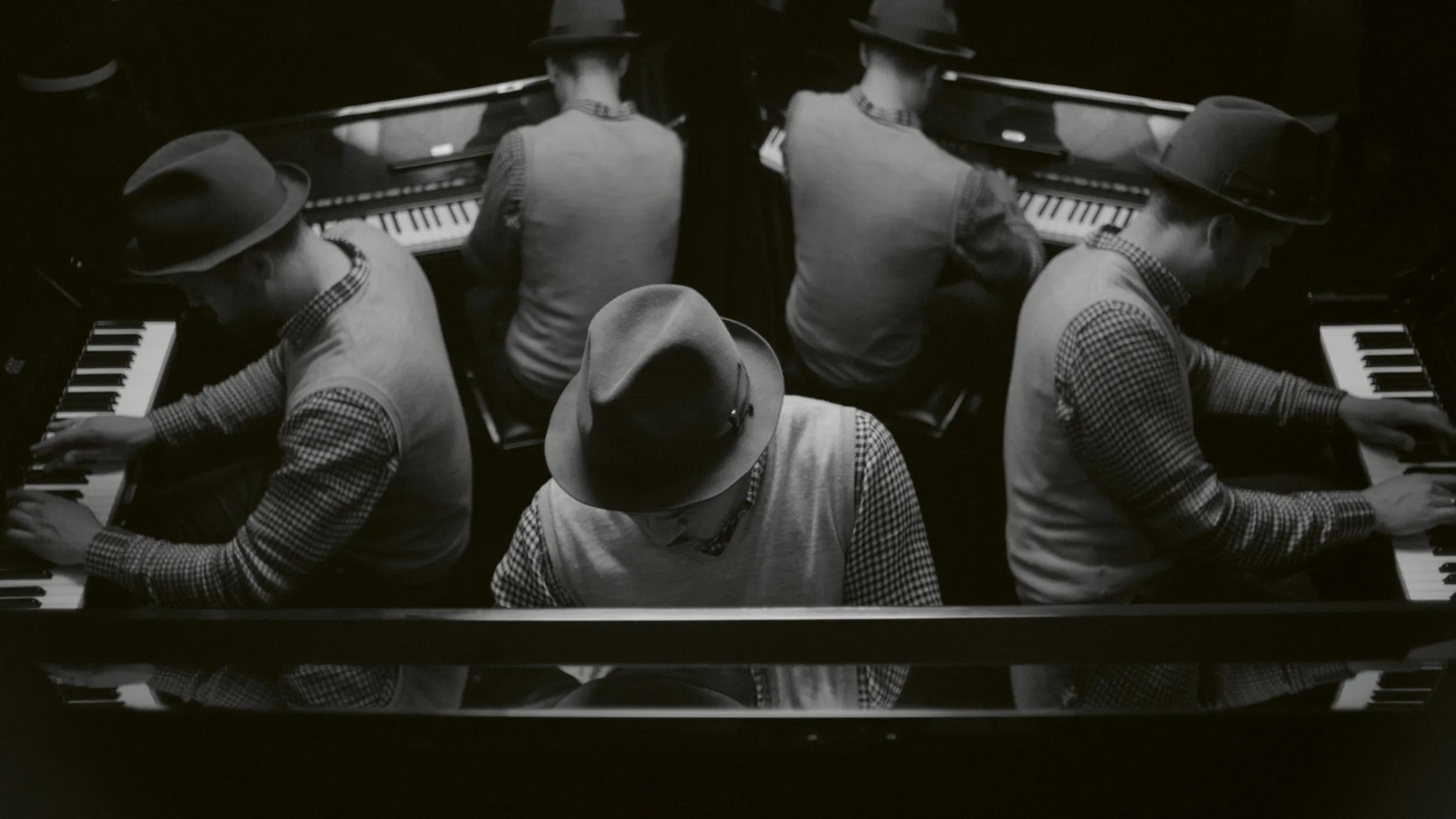
Still from Chess, 2013
JM: Right. Just really as a force. And I think sometimes, early in a career, we might say, “Okay, well, this kind of works, and I’m going to stick with it.” But seeing your shows over the years, I watch you keep up this kind of … I’ll call it bravery. Bravery to say, “It’s time to move on to something else, time to do something new.” I think about Venice, about Okwui Enwezor’s Biennale in 2015, “All the World’s Futures,” which you were in, and I wonder why, at that moment, you felt that painting was the next move?
LS: The move really came before the idea of Venice. I had formal conversations with Okwui. And there was no guarantee, no “You’re invited.” He was like, “What are you working on?” Skeptically. “What are you working on?” And I’d say, “Well, it’s this.” And he was very supportive, but it was a true moment for me of not being sure what I was doing as an artist and just experimenting and going with “Let’s see what happens.”
JM: Wow.
LS: I’m ever grateful for that opportunity to make such a big shift in the work. I am not the kind of artist who ever says to herself: “Oh, this? This is going to be great.” And I’m not saying the work is great. I just mean that I never look at things with that sense of being assured, of, quote, unquote, “success.” It just has to be interesting to me, the process has to be interesting. And it was. And it all ended up being a nice surprise. But it’s also about having no choice, as an artist.
JM: And now you’re coming back to Venice with all these other paintings, all these years later.
LS: Taking the iteration of these works that was at the Metropolitan Museum of Art to the Punta della Dogana is very daunting because the space in the galleries at the Met was much more succinct and much more linear, more confined. In Venice, it’s going to be me experiencing the paintings in a new way, kind of learning what works, what doesn’t work, learning how the pieces act in conversation with themselves. It really takes being in the space for me to understand those things.
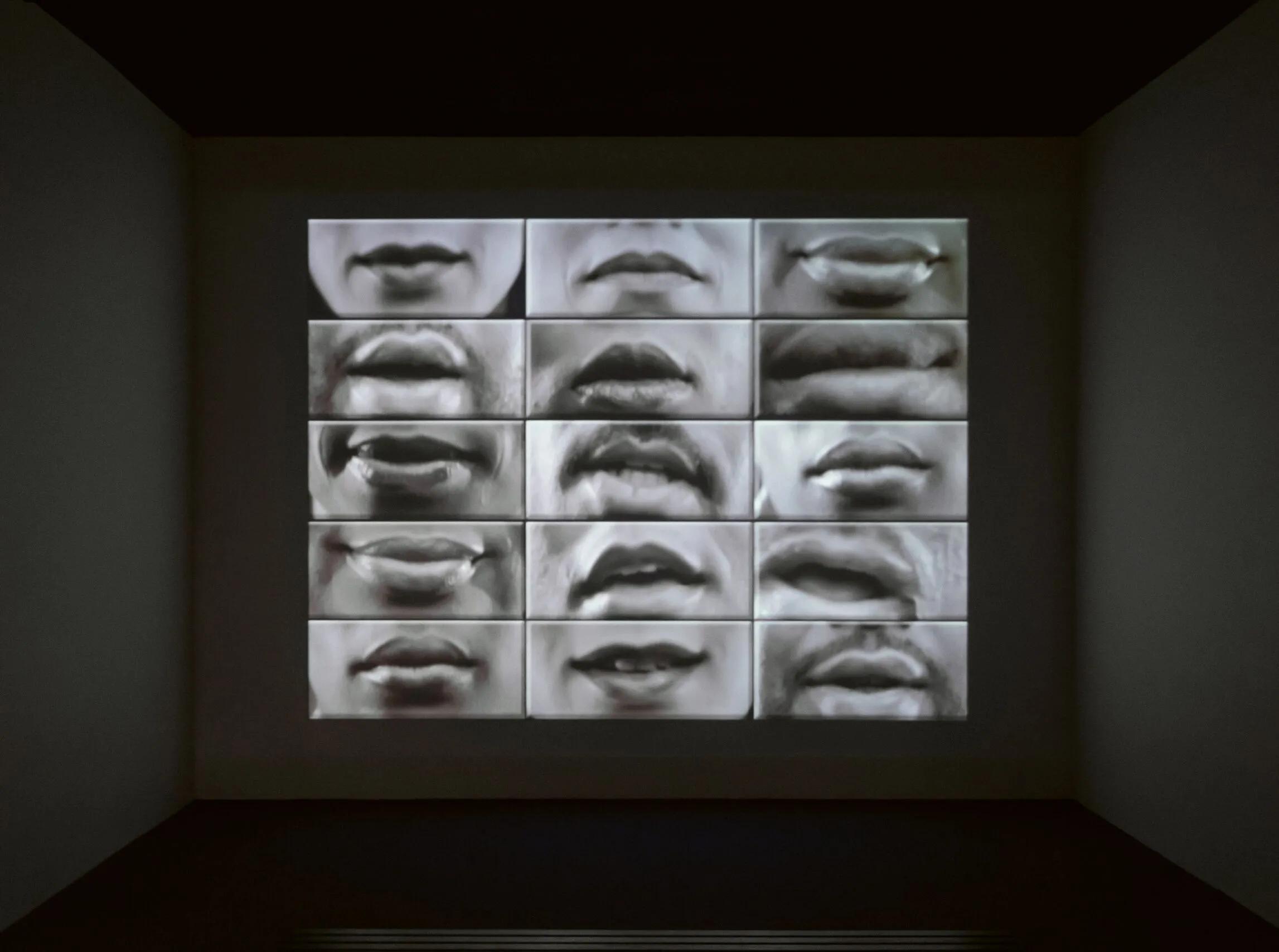
Lorna Simpson, Easy to Remember, 2001 © Lorna Simpson. Photo: James Wang
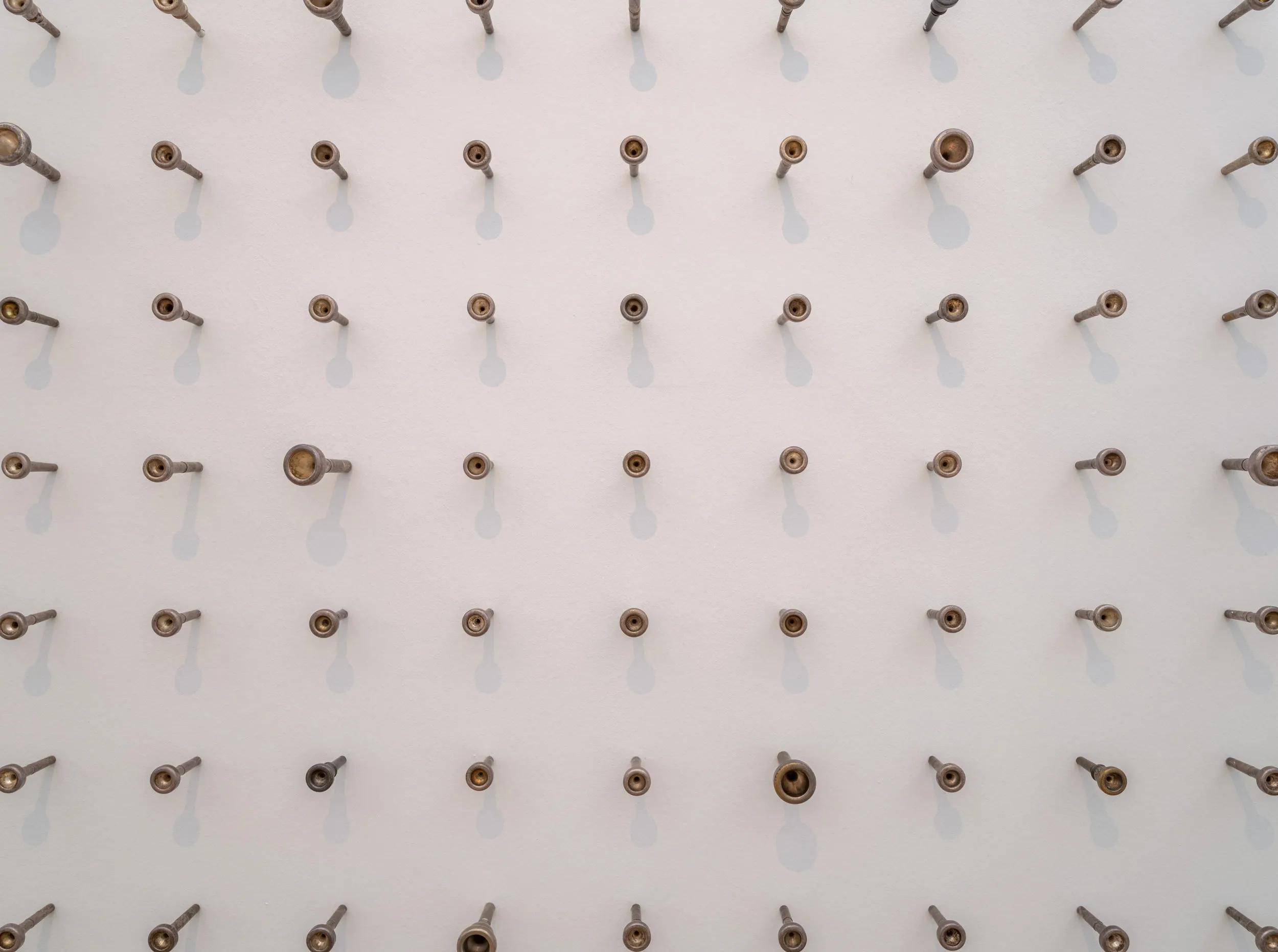
Lorna Simpson, Hypothetical?, 1992 © Lorna Simpson. Photo: James Wang
LS: I’d say that applies in the context of your longtime collaborator, Joan Jonas, and the beginnings of that work with her and her invitation. I’ve heard you speak about that before, the radical looseness of her proposals to you. Like, just: “Okay, be present and let’s go.”
JM: Yeah. But she also says, “I’m not improvising. This is very worked out. I practiced this.” And so there’s a rigor to what feels like improvisation, and, of course, that’s what I’m doing too. Early on, when we started working together, I had no idea what I was getting into.
LS: Right. Which is beautiful.
JM: It was great. Because her invitation was so open. It just sounded like it was going to be a blast. And in the world leading up to that collaboration, around 2004 and 2005, my world was very much about one thing. I was on Blue Note Records. I was making jazz records, playing jazz clubs and festivals. I was jazzy, jazz, jazz. Then she comes along, and it’s a real jut against all of that. Adrian Piper also showed up in my life about the same time. And I always say this, because I think it’s important for my timeline, that this is when my mother died. And then I meet Joan and Adrian. They don’t necessarily step in as mother figures, but they kind of do. I don’t talk to them about my mother passing away, but maybe they just knew. I think especially Joan. Over two decades of collaborating, the only thing she always asks is that in each piece we have to make sure we have a duet improvisation together. She’s like, “Got to have it.” The ways she works—with found text, stories, mythology from around the world, multiple traditions, landscape, documentation of her life with her camera—frequently involves her friends. It’s very much a family, a crew, and she’s loyal to the crew. These kinds of collaborations have been very important relationships for me, and it’s why in 2005 I made a record called Artist in Residence, and I put both Joan and Adrian on the record. It was about making the statement that they are as important to me as Thelonious Monk, and they should be a part of the Blue Note’s catalogue history. Their names should show up in jazz history as important developments in how people think, not only about creativity but also about psychology and about how we use the stage. The first thing you and I did together was Chess, in 2013, and I remember it so vividly in so many ways. Maybe none of them are right.
LS: Tell it. Let’s hear what you have to say.
JM: I feel like you told me, “I’m working on this piece. It needs music. Has to have music.” And then the next term I remember hearing was “mirror.”
LS: Right.
JM: You said to me, “Mirror.” And I thought, “Mirror, mirror, mirror.” And that sent me into trying to develop a score based on Brahms’s piano exercises in which the hands are mirroring one another, an incredible exercise he wrote. And I remember that you just left it open. You said, “Okay, so show up on this day to my studio.”
LS: Right. I think these kinds of things should begin with a prompt and then you let it go, see what happens. A directive would be presumptuous and not interesting. Mirroring was a small prompt. And it was amazing. I remember in filming you sitting at a kind of forty-five-degree angle, mirrored so that there were five of you, as if it was a group of Jasons sitting in a kind of circle playing the piano. And the music was breathtaking. Of course, you could hear a pin drop. We were all saying to each other, “Please, nobody cough. Please, don’t let any planes fly overhead. Please, absolute silence.”

Jason Moran and crew members during the production of Lorna Simpson’s Chess, 2013. Photo: Yosra El-Essawy
“There’s a spiritual quality to singing bowls, about how the sound emanates from them, that I’ve always found interesting. You think the sound has stopped, but it hasn’t. It’s still vibrating, although you may not be able to hear it, which is incredible.”—Simpson
JM: This piece originally stemmed from vernacular photo-booth images that you’d found?
LS: They were from found images that I’d discovered on eBay, of an elegant man and woman photographed doing staged poses in Los Angeles in 1957 and that led to a series of mine called 1957–2009, in which I photographed myself mimicking the scenes and poses in the photos, mirroring them. There’s one moment in the vintage images where the man appears smoking cigarettes and playing chess, and there’s also a picture of the woman playing chess and I mimicked that. And I began to think about the idea of someone playing a chess game against themselves. The interesting thing about these found photos to me was that they were not documentary. They’re very stark setups, very staged and art-directed. So it started to feel appropriate to have a soundtrack to accompany these setups—or what’s a better word than “setups”?—these imagined images.
JM: Right, situations.
LS: Situations and scenarios that they’re performing for the camera. It was all artifice, and I wanted to keep that intact. It wasn’t like, “Who are these people, really?” But at the same time, I was fascinated by the creation of these fictions, in 1957 in America, in Los Angeles, what these fictions were saying about this Black man and Black woman at that time and how they wanted to be seen.
JM: We’re still creating these fictions in 2026 in America, aren’t we? I mean, I don’t want to pull us too far into the contemporary situation, but …
LS: That’s okay.
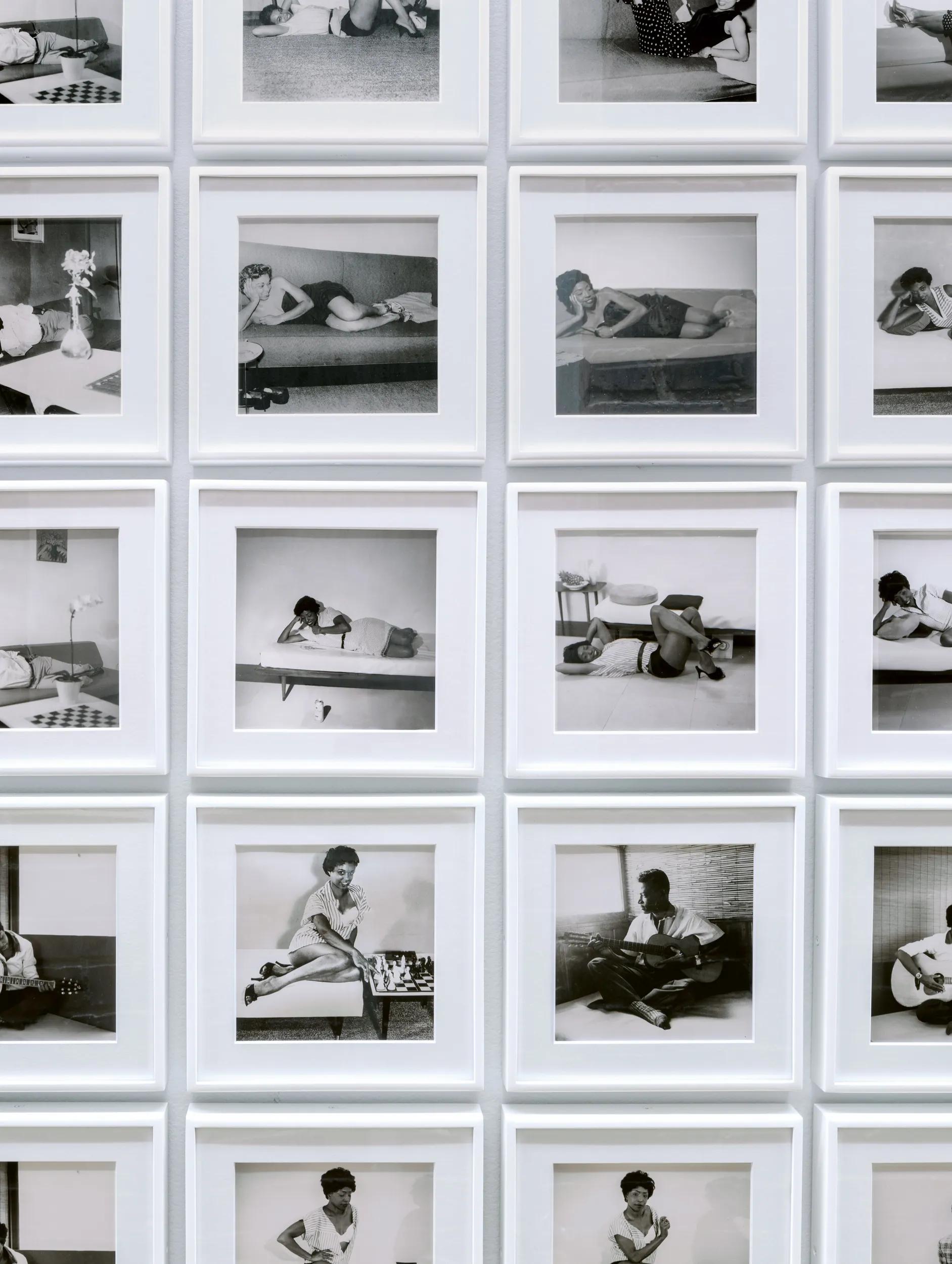
Lorna Simpson, 1957–2009, 2009 © Lorna Simpson. Photo: Blaine Campbell
JM: Sometimes I wonder, when people ask me: “How is your work changing because of how you feel about the world today?” I think maybe they should ask me instead: “How have you changed based on what you’ve just witnessed on the news, or witnessed on the street, or based on worrying about your family and loved ones?” I think a lot about your last gallery show in New York, “Earth and Sky,” work you did before the last presidential election, those ominous paintings of bullet holes and huge meteorites that seemed to be hurtling toward the earth. It was all very dark.
LS: Well, it’s the darkness that we’re living in now.
JM: And it all arrives like a rock smashing down.
LS: Destroying every fucking thing and person and idea and history.
JM: I feel like I’ve been saying not only to myself as a performer but also to younger musicians I work with: We go onstage to make music, but we’re also responsible for how we send our audiences back out into the world. It’s on us. How do we leave them? What’s the last song that says something about the world they’re going back into? Do you think about the image in an exhibition that you want people to carry out the door in their consciousness?
LS: I’ve never been able to make an assumption about the way an audience will respond to my work. It’s a kind of black box for me. People bring their own experiences, their own emotional tenor. In the making of Easy to Remember, I remember thinking that the music was quietly comforting and warm and dreamy. And everyone else was like, “Lorna, it’s so dark.” September 11 was right around that time, when the work was released. So the tenor of the time also framed the work. But there is something about that particular harmony of people humming together—I didn’t notice it while looking at it a million times in editing—that was deeper and darker in its emotional tone than I thought.
“There are certain frequencies that, if you give them to people, they suddenly get everyone on the same page. You have to be careful with it. Ellington wrote these incredible pieces in the key of D-flat. And that key, as a frequency, somehow just makes the body feel different.”—Moran
JM: It’s interesting. I know from making music long enough that there are certain frequencies that, if you give them to people, they suddenly get everyone on the same page. You have to be careful with it. Ellington wrote these incredible pieces in the key of D-flat. And that key, as a frequency, somehow just makes the body feel different. It makes you feel more emotional. It’s more unsettling. The key of E is completely different. It has a brightness and a tone. They’re all different and when you play a set, you’re building up layers.
LS: An emotional layering.
JM: You’re shifting people’s chemistry. And then you’re sending them out into the world, and they’ll hear some of that in their life.
LS: As it reverberates.
JM: Which kind of brings us to your work Stacked Stones/Vibrating Cycles, the work that incorporates singing bowls. When you installed that in the courtyard here at Hauser & Wirth in Los Angeles in 2021, it was during the pandemic and people were in isolation and so much wanting to get out. And when I saw that work in the courtyard it had a sense of hope about it, that people might be able to gather outside and listen to these ethereal sounds from these objects during a time of so much distress and isolation. But because of where we were in the pandemic, a performance didn’t eventually happen. And now we’re picking up the idea again.

Installation view of “Lorna Simpson: Third Person” at Punta della Dogana, Venice. Artworks: 5 Properties, 2018; on walls, left to right: Head on Ice #4, 2016; Head on Ice #3, 2016 © Lorna Simpson. Photo: James Wang
LS: In a very different context.
JM: Right. And also indoors now. Here in L.A. back in 2021 I spent time in the courtyard and we shot some footage of me playing the bowls, testing them out and I thought, “I really should try to write something for these bowls.” And I started, but it never happened.
LS: I’m so happy that you’re working on it again.
JM: I actually think I’m ready now. Back then, I was looking at the collections of tones that you chose, the tones of the individual bowls, G’s and D’s and A’s and E’s, and thinking, “How do I make something?” Now I think I know.
LS: Maybe the time you’ve had since then—it just sits somewhere else for a minute.
JM: One of the more beautiful things about the singing bowl, so different from, say, a piano, is that when you press a piano key, the sound is almost immediate, because the hammer strikes the string and the sound comes out—like, pow. The bowl, though, has a kind of vibration. It’s like a string but different. It has to get going, and then it starts to resonate. And even when it resonates, it requires you to keep it resonating. There’s something pretty humbling about that because it’s not precise like a concert instrument.
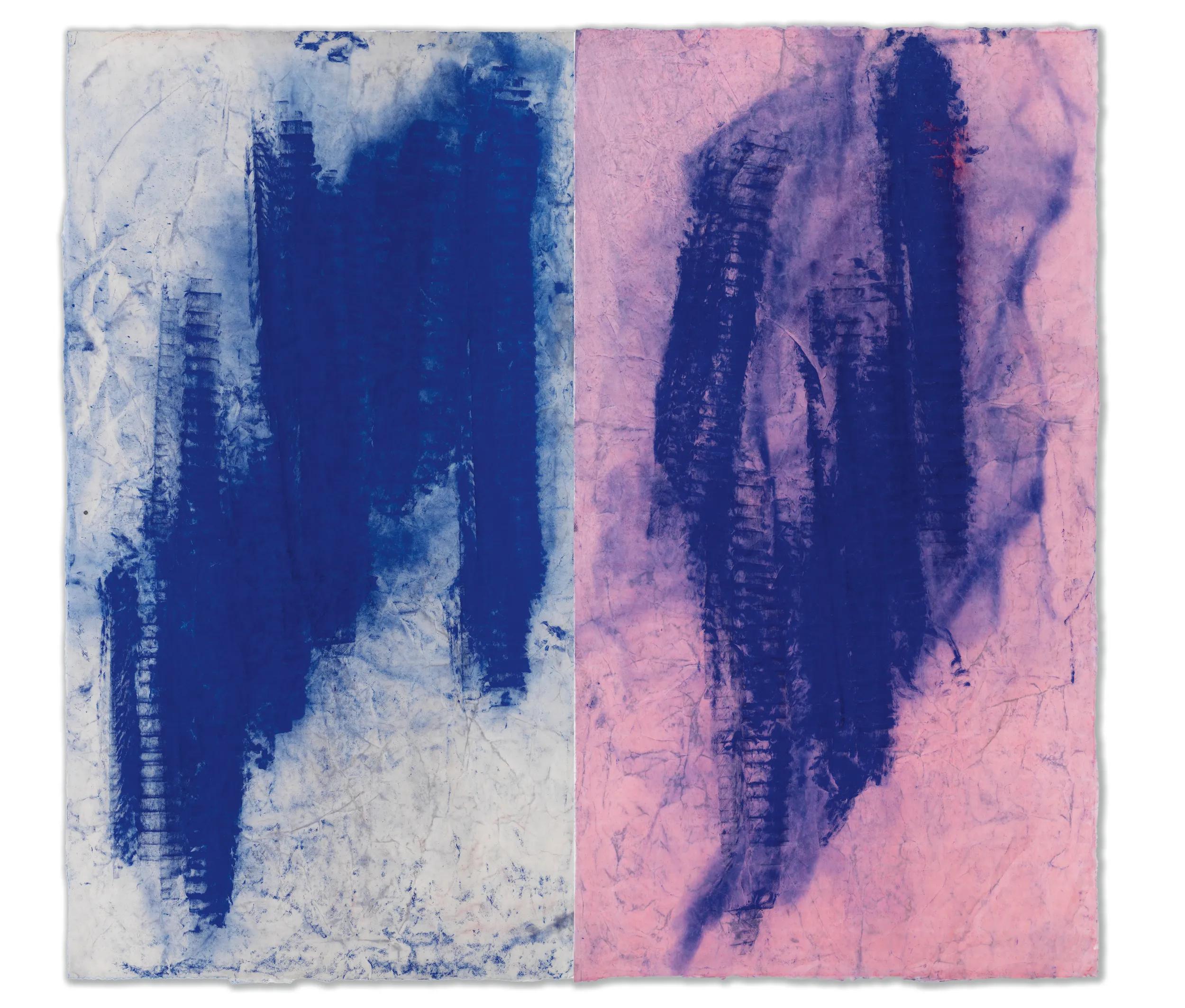
Jason Moran, His mother talked to him about God 1, 2022 © Jason Moran. Photo: Genevieve Hanson.
LS: I think the feeling about it depends on what culture you’re from. There’s a spiritual quality to singing bowls, about how the sound emanates from them, that I’ve always found interesting. You think the sound has stopped, but it hasn’t. It’s still vibrating, although you may not be able to hear it, which is incredible.
JM: It makes me think about cymatics. Do you know about that?
LS: No.
JM: It’s about showing how sound and vibration create physical patterns in things like water and sand, basically the physical structure of sound, its shape. And for some reason thinking about that phenomenon makes me think about the colors in your paintings, the layers and layers of blue that kind of make me feel as if color itself has shape when I walk into some of your shows. It feels like a pulse. Is it gauche for me to ask you: Please tell me about blue?
LS: Well, it’s blue, but it’s also blue and purple and purple-blue-brown. There’s a little bit of brown in there, even though you don’t perceive it. You get different shades and hues that are all contained under what’s called, quote, unquote, “blue” to make something that registers not only as blue but as something else hard to articulate. They all come together to form a depth.
JM: Over time, looking at them, I feel very much as if they’ve accumulated in depth in my mind.
LS: Well, let’s hope they hold up in the Venetian light.
JM: I’m pretty sure they will.
–
“Lorna Simpson: Third Person” remains on view at Punta della Dogana through November 22, 2026.
Jason Moran Plays Duke Ellington is now available on Bandcamp.
–
Lorna Simpson came to prominence in the 1990s with her pioneering approach to conceptual photography that raised questions about the nature of representation, identity, gender, race and history. Over thirty years, she has continued to probe these questions while expanding her practice to encompass various media including film and video, painting, drawing and sculpture.
Jazz pianist and artist Jason Moran is deeply invested in reassessing the relationship between music, language and location. He has collaborated with artists such as Joan Jonas, Lorna Simpson, Glenn Ligon, Julie Mehretu, Adrian Piper and Kara Walker. He currently teaches at the New England Conservatory.